Tensegrity
Tensegrity is "God's geometry", as developed by Buckminster Fuller. In KMI (and other approaches to bodywork), the tensegrity view on the body opens new avenues of holistic strategy for understanding how the body works, how it compensates, and how to understand some otherwise incomprehensible behaviors.
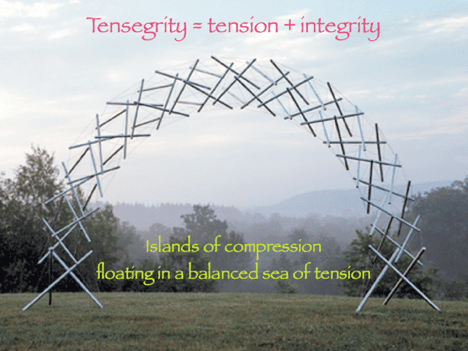
"Tensegrity" derives from collapsing the words "tension" and "integrity" and means that the integrity of these class of structures depends on the balance of tension within it.
All structures in the universe are supported by a balance between tension and compression, between "push" and "pull". The chair sits on the floor, the lamp hangs from the ceiling - that's all the ways to support something there are. Shear, bending, and other forces are just combinations of basic tension and compression.
We are very used to looking at and building structures that rely primarily on compression for support. The brick wall is the classic example: one brick is piled on top of the other. This is a "continuous compression" structure - where the compression created by gravity is carried from one brick to another, all the way to the ground. The bottom brick has to be compressively strong enough to carry all the bricks above it.
 Nobody asks what a brick wall, or a house, which is similarly constructed, weighs. Weight is rarely a consideration in continuous compression structures. Bodies, however, are constructed with strict evolutionary limits on weight, so continuous compression is not a good model for building a body.
We have acted, however, in contemporary kinesiology and anatomy, as if this were the case.
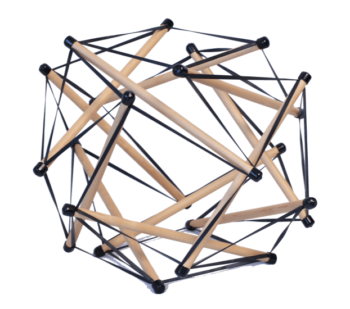
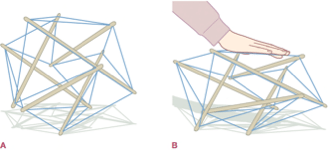
But a body is in fact more like a balloon. A balloon is a classic tensegrity structure. The skin is the "tension member" - pulling in. The air is the "compression member" pushing out. The skin pulls in until it balances the air pushing out, and that determines the size of the balloon. Substitute a series of dowels for the air, and put rubber bands in place of the balloon "skin", and you have a classic tensegrity structure.
Substitute bones for the dowels and the fascial and myofascial membranes for the balloon skin and rubber bands, and you have "fascial tensegrity".
Tensegrity and the Spine
(from Body3 - available in our online store)
 Let's think about support in the human backbone, exploring its "springy" nature and wondering how to bring about the "lift" we recognize in a healthy spine. Last time, we looked at the front column of the spine, the discs and vertebral bodies, and compared it to the back of the spine, the neural arches and their processes. We meandered off down several sideroads, so our thesis thus far, which we will complete in this installment, can be summed up simply: The front of the spine is a poor candidate for a supporting pillar, even though it occupies the more central position in the body. This part of our "spinal column" consists of spongy bone in  the vertebral bodies ("lava rocks") interspersed with squishable discs ("water balloons") - hardly a strong candidate (see Figure 1). The posterior section of the spine, the neural arch, consists of more solid bone bristling with spinous, transverse, and articular processes. Is this perhaps a better bet for a weight bearing structure?
Mechanical explanations of the spine, like current explanations of the brain or the universe, are always incomplete. But looking at the possibilities may spark new conceptions and open new avenues to our minds and hands. And the particular possibilities we look at here speak directly to a soft-tissue approach to spinal health.
 Looking briefly, as we so often do here, to our four-legged friends, we see the weight-bearing function of their spine is totally different from our own (unless we are young, sick, or inebriated enough to be stuck crawling, of course). The spring of the spine, stretched like the cables of a bridge between the supporting towers of the pelvic and shoulder girdles, is kept from sagging to the ground:
- a little bit by the weight of the head and tail cantilevered off either end,
- principally by the sling of the anterior longitudinal ligament stretched from one end of the spine to the other,
- supplemented by the tension of the abdominal and chest muscles, which, by shortening the ventral side of the body, work to help keep the spine more or less horizontal.
Gravity goes obliquely across their spines, not through them, so there is very little pressure on the bodies and the discs, except as exerted by the animal's muscular effort. The spinal muscles, surrounding the neural arch, have little postural function and are free to guide the movement of the spine in orientation and locomotion. Because of this arrangement, our four-legged friends have need for fewer chiropractic adjustments, though failure of the system can still result; witness the swayback of the old or overweight horse, for example.
Our spine, straight up and down in gravity, presents a different set of problems, solved quite differently by nearly the same set of muscles and bones. Or, as with the case of the sacroiliac joint we looked at in the column called "Poise" (Massage Ma #__), is it in fact as different as it first appears? As with so many parts of the body, the answer is multiplex and not yet fully answered, but let us go on a journey of exploration.
Tensegrity Continuum
There are only two ways we know of to support anything in our local universe: tension and compression. If I want to hold something up, I can hang it from above, or brace it from below. I can hang the picture from the wall, or set it on the mantle. All the other forces in the universe - shearing, bending, twisting, etc. - are more-or-less complicated combinations of simple hanging and bracing.
All supported structures exhibit a combination of hanging and bracing. A tree is braced into the ground, but the branches and leaves hang form the trunk. The quadruped spine is hung from the braced girdles. Planets hang from the bracing sun.
Interestingly, tension and compression often operate at 90 degrees to each other. Tense a rope and its girth goes into compression. The fibers crowd closer and closer together. Load a pillar, and its girth widens slightly, as the weight it is supporting pushes its molecules apart into tension. If you pull on a rope, its fibers compress together. If you push on a pillar, it gets (maybe only a very little) wider in the middle. Let us look how some people have modeled tension and compression at play in the spine.
Newton's Stack of Blocks
 This "stack of blocks" is the standard "Newtonian", mechanistic model of the spine. This view is so much a part of our thinking that we can hardly think of the spine in any other way. It looks something like a stack of checkers, so it is easy to think of it as a "continuous compression" structure. "Continuous compression" is a complicated term to explain most of our simpler architecture from a cairn of rocks to the Washington Monument. The weight is carried down directly from compression member to compression member all the way to the ground. No tension members are necessary at all.
Recognizing the limitations of applying this very simple model to the spine is as simple as imagining that all the soft-tissue around the skeleton suddenly disappears. In even the most delicately aligned person, the skeleton would clatter to the floor; it is not a very well-stacked set of blocks.
 To evoke that image, you probably thought about the skeleton that stood in the corner of your massage classroom. Was that skeleton braced like a stack of bricks, like a "continuous compression" structure? Most likely it was not braced from the floor, but rather it was hung from a stand, wired together with its feet off the ground. It is interesting and puzzling: we are steeped in the idea of the spine as a column and the skeleton "stacked up" from the ground. Yet all the while the evidence that it does not work very well that way is easily seen in the very way we display the skeleton in classrooms around the world.
If "continuous compression" does not account for the support of the spine, then some of the integrity must depend on the tensional part. "Tensegrity" is Buckminster Fuller's coined term for structures where the integrity depends on the tensional members. Let us move gradually, though, from the stack of bricks toward these strange and wonderful bits of architecture, for there are instructive images each step of the way.
Counterbalance
So our first admission of some role for soft tissue (and the role of tension - physical tension, not problematic tension) comes through seeing that the bricks - we are, after all, a very tall, thin stack of bricks like a radio tower - need simply to be counterbalanced by centers of muscular pull.
In the illustration at right, we see an image, derived from the work of Mabel Ellsworth Todd in the 1930's, of how the centers of muscular pull counterbalance the tendency for the skeleton to collapse. The counterbalancing forces wave back and forth from the front to the back of the body: the bottom of the foot, the back of the calf, the front of the thigh, the butt and lower back, the chest, and the back of the neck. Throw the system out of balance and you require excess tension in a pattern of places not designed for it: around the heel, the front of the shin, the hamstrings, the groin, the mid-back, and the throat-jaw, for example. Sound familiar?
Notice that this model still involves the idea of a continuous line of compression down to the ground; the tensional element merely modulates the tendency of this stack to collapse. We do not have to look very far into our experience to find another model, more dependent on tension for its integrity, which also has application in the body.
Mast and Stays
In a sailboat, the mast, a spine-like event if ever there was, is likewise a continuous compression structure: from its "step" in the keel up to its head, and it carries its own weight when the boat rests at anchor. But spread some sail in a morning northerly, and the pressure on that stick of wood becomes enormous, more than even good Maine pine, or even good Argentinian aluminum could stand. Masts, therefore, are reinforced with steel "stays" that help take the strain. Without them, an unreinforced mast, to be strong enough, would have to be so thick that it would sink the boat. And we already noted last time that if the spine were holding all our weight, L5 would have to be much bigger than it is. The same physics are at play in both cases.
The body, as we have illustrated in figure above (following another thinking anatomist of the 1930's, the German Molliere), exhibits this same pattern. If the spine is the mast, the two "cables" of the longissimus complex in the erector spinae act like forestays, pulling down and back against the tendency of the rib cage "sail" to pull the mast off center. The scalene muscles act like the "throat halyard" (some old sailor must have noticed the comparison), pulling up on the "gaff" of the first rib. The rectus abdominis can be seen in the same light as the "sheet" that ties the "boom" of the lower rib cage back to the hull of the pelvis. Cute, huh?
Yes, cute and interesting, but we are not done yet. The mast is still one solid piece, and our spine is segmented. Can we model some kind of support that has a column that is segmented and still provides support. Yes, we can, but we will have to rely still more on tension.
The Plant Stem
The architect who developed the structure below — another German (always thinking, those Germans) — was trying to figure out how plants hold themselves up, and specifically how sunflowers might turn themselves to face the sun. In the process, he made a singular contribution to our understanding of spinal mechanics.
This "mast" is made from segments that fit loosely into each other, like a series of golf tees with a ball-and-socket type of cup at the top. Left to themselves, you couldn't stack 'em up for love or money. Attached around the "neck" of each of these segments is a circle of plexiglass, with a series of holes drilled into it every 120 degrees, so there are three sets of holes in each disc. Now the bottom unit is the biggest, and has, say, 12 sets of holes from the center to the circumference; the next one up is slightly smaller and has 11 holes, the next one up has 10, and so on, up to the very top one, very small, with only one circle of holes.
Now, if you have nothing better to do, help me thread cables up through these holes. We will need 36 of them, right? But the outermost set will only go to the first disc, and there we will fasten it tight to the disc. The next wire in will go through the first disc to fasten to the outer hole in the second one up. And so on, until we get to the innermost cable, which will pass up through all the discs, close to the central stem, to fasten to the tippy-top little disc. (Otto's original mast was 35' high).
Hey, don't leave yet - I still need your help to wind all 36 of these cables on drums. What a complicated mess! But when it's done, we can, by pulling on the cables in different combinations, make this mast twist, turn, and bend in any direction within the hemisphere defined by its radius. And by securing the cables, we can stabilize it in whatever curvy position we like.
So this mast acts even more like a spine: it is segmented, and it can bend and twist in a variety of ways. (The movements of our own spine, as we saw last issue, is actually more limited by the shapes of the facet joints.) But does our spine have anything like these cables? Yes, it does, almost exactly: the iliocostalis group in the erector spinae (Figure 8 or Netter plate ____). Look, it starts as a bunch of cables coming up from the ilium and sacral fascia, with one slip stopping on the 12th rib, the rest moving on up. There is a slip stopping on the 11th rib, and the 10th, and so on all the way up into the neck, where it attaches to the transverse processes when the ribs run out.
The iliocostalis
This is the muscle that allows you to lean sideways under the sink, twist to peer up at the drain, twist a piece of you the other way to get your arm in, and then fix the whole thing to be stable enough for your shoulder and arm (and a wrench) to get the nut at the trap loosened.
Notice that this arrangement is even more dependent on the tensional members to stand up. Cut the stays on a sailboat and the mast will still stand; cut the wires on this thing, and it would collapse just as our skeleton would without cables.
Tensegrity
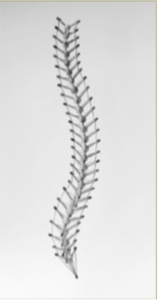
There is one final step we could take, to what the artist Kenneth Snelson discovered, and Bucky Fuller popularized and termed "tensegrity" (figure 9). Tensegrity masts have compressive segments that bristle with "processes" (like the neural arch). The strings or wires are arrayed around these segments in such a way that the hard parts are supported in space without actually touching each other. It is necessary, however, that some of the sticky-outy bits of the upper segment project down below the upper processes of the lower segment, otherwise these structures would defy physics altogether, instead of just having that appearance.
Notice also, that the outer edges of the processes are also strung all the way up the structure from segment to segment. If you tighten these longitudinal wires, the structure will get shorter, and the compressive segments will get closer to each other, ultimately touching. Conversely, if you tighten the circumferential , more horizontal fibers, the structure will get longer, and the segments will move away from each other. In other words, these structure have no "continuous compression" whatsoever, and therefor can truly demonstrate "lift".
These structures have a number of properties that are very interesting in terms of their relationship to bodies, which we do not have space to go into here. Chief among these is the interesting property that strain applied to one part of the structure often causes deformation quite distant from the site of application. And is this not so often the case in structural bodywork? - where we need to work is "where it ain't", not at the site of pain itself.
Our Models Applied
Now that we have seen all these models of applied combinations of tension and compression, can we meld them together into a model of spine?
Our first problem: how could the neural arch be the main weight-bearer of the spine if it sits so far to the back of the body? If you have a central tentpole, it holds the circus tent up much more easily than a tentpole off to the side. If the tentpole is off to the side (and you can see some wonderful examples of this in some newer structures like the Munich Olympic village and Denver's new airport, where your intrepid columnist is waiting for yet another delayed plane), then you must have some strong and substantial guy-wires pulling away from the body of the tent to counter-balance it.
In the body, therefore, there would have to be some active wires pulling down behind the neural arch to counter-balance the tendency of the rest of the body to pull the neural arch into flexion. And of course they do exist: the entire set of erector spinae and transversospinalis muscles.
The Spinal Muscles
Let us examine these muscles in a bit of detail, because so many massage therapists look at the welter of muscles traversing the spine and say, "Forget it! That's too complicated for me, I'll leave it to the experts and just work on whatever hurts." We do ourselves a double disservice when we think like this. For one thing, the holistic soft-tissue approach is capable of doing many good deeds for the body movable, and the developing field of bodywork is going to make this whole journey, sooner better than later. So we cannot throw up our hands, because we are the experts in the field of whole body function. Experts these days, by definition, specialize. We are unique: experts in seeing, feeling, and listening to the whole gestalt of everyday development and function. That means we need to know a lot and be sensitive to feeling a lot. So, all hail Upledger, Rolf, Trager, Feldenkrais, and a host of others: not so much for the fine techniques they leave us- though they are surely useful - but because they lead us to feel something new about the whole system.
I'll get off my high horse to explain the second reason we should not dismiss the back muscles: once you understand the pattern, the whole mess falls into place and is readily understandable. (Not that that makes it easy, mind you, but at least not an unclimbable wall.) I give total credit for the following schema - along with many thanks for the practical help it has been to my practice - to The Great Clarifier, Jon Zahourek, developer of the Anatomiken and Zoologik series.
Figure 10 - Jon Zahourek working on one of his Maniken tools
Caption: The pioneer Jon Zahourek, here with one of his Maniken models, has illuminated pattern after pattern in the evolution of vertebrate structure.
The spinous and transverse processes (SP's and TP's) provide a trusswork for the attachment of the many ligaments and muscles that surround the spine. These muscles form in three patterns, exemplified by the deepest, shortest, and most ancient of the spinal muscles. The intertransversarii (long name for a tiny muscle) pass from transverse process to transverse process, one segment at a time, all the way from the bottom to the top of the spine (Netter plate ____). They are involved in lateral flexion, and in that most ancient of spinal movements, the side-to-side sweep of swimming. (Sidebar on spinal reflex and swimming movement, or is this too much?) The interspinous muscles run from spinous process to spinous process, also covering just one segment. These muscles act to approximate these spinous processes, thus creating spinal extension. Both these sets run vertically, parallel to the spine.
The third primary set of muscles, the rotatores, run from spinous processes down and out to the transverse processes, like pine tree branches. They help with spinal extension, but, true to their name, they also help to create spinal rotation.1 The rotatores brevis cover only one segment, but the rotatores longus cover two segments, passing from the spinous process of one vertebra to the transverse process of the vertebra two segments down. Thus the rotatores longus are angled more steeply, more vertically, but still like a pine tree.
Figure 11: The three primary muscle patterns- intertransverse, interspinous, and rotatores
Caption: Deep in the spine, and deep in our history, lie these three patterns of spinal musculature.
The overlying layers of spinal musculature - the multifidus, the semipinalis, and the erector spinae - repeat the basic patterns of interspinous (SP to SP), intertransverse (TP toTP), and rotatores (SP to TP). As we move out toward the surface, the muscles cover more and more segments, until at the surface we have the muscles familiar to our hands that span the entire spine.
Though a full explanation requires more space than we have here, the spinalis muscle - most easily felt in the middle of the back right next to the spinous processes - and the semispinalis muscle form the SP to SP pattern. The longissimus - the easily felt "cables" that run the length of the spine - creates the SP to TP pattern, though some of them run in an "oak tree", v-shaped pattern rather than the original "pine tree" pattern. And the TP to TP pattern appears in the iliocostalis, whose corduroy slips can be palpated out near the angle of the ribs (figure 12 and Netter plate ____).
Figure 12: Spinal muscles, real and diagrammed
Caption: These outer muscles reflect larger, many-segmented expressions of the deeper, inner muscles.
We have said that for the neural arch to work as a weight-bearer, these muscles would have to be pulling down in the back, and this they certainly seem to do. The longissimus and iliocostalis groups are firmly anchored in the sacral fascia, and if these muscles are totally relaxed, our bodies curl forward into flexion.
Figure 13: Vertebrae as 'hinge'
Caption: This image, lifted from Kapandji's The Physiology of the Joints, shows how the downward pull of the back muscles could take pressure off the discs.
We can now see how this whole structure would work to 1) support weight, 2) protect the spinal cord, and 3) take pressure off, rather than put it through, the bodies and discs. The relationship between the vertebrae can be seen as a bit like a reverse leaf spring, or, more simply, two saucers resting "back to back" on each other. The fulcra in the middle are the articular facets, located, for most of the spine, just beside or behind the spinal canal. As the muscles pull the spinous processes toward each other and toward the sacrum, it would actually lift the front of the vertebrae, taking pressure off the discs and spinal cord. It would work against spinal stenosis, and actually stretch the anterior and posterior longitudinal ligament. And, of course, prevent us from falling into flexion.
In this model, the spinal meninges, the dura and pia mater, as well as the cord itself, are delicately poised in the safest, steadiest area just in front of the sprung fulcrum.
Figure 14: Sagittal vertebrae, with forces
Caption: The equilibrium of forces across the healthy spine allow the springs to work at maximum efficiency.
The fact of the matter is, however, that these are not the only forces at work. Excess muscle tension in the abdominal and other flexors of the ventral surface, whether created by over-exercise or emotional holding, can overcome this natural balance, pulling the spine into flexion patterns - the weight-lifter's kyphotic dorsal spine, a "flat" lumbar spine, a dowager's hump, and a host of variations we see every day. "Caving in" to these patterns, by the light of this theory, would start to put unaccustomed pressure and weight through the bodies and discs, initiating the host of bulges, herniations, and other pain producing aberrations.
Furthermore, the spinal myofasciae, trying to create their normal downward pull, and further struggling against the additional pull from the body's flexors, are put directly into strain where they go into spasm or otherwise move out of place (narrowing, widening, or twisting depending on the situation).
Whoops! - this theory is very inconvenient: are we not trying to relax the back muscles? But if we do, according to this theory, would it not result in pitching the spine more into flexion, or compromising the discs? Not the good result we were looking for. There are two responses to this. For one thing, we certainly do have to counter-balance any relaxation we get in the back extensors with work to relax the trunk flexors, otherwise we may get temporary relief at the cost of long-term increase of problems. Secondly, we value balance - an evenness of tone - across the complex of back muscles, rather than valuing relaxation of any single part. The back muscles, after all, have to have continuous tonus to keep us from falling over. The key is the consistent balance of this tension - what Rolfer Jeff Maitland termed "palintonus" (even tone) - that keeps us out of pain.
The second troubling aspect of our theory is that putting the weight down through the neural arch means that this weight will press the articular facets together, compacting the joints and creating pain. But we already have seen a model that can be applied here.
If the articular facets are the true fulcra of spinal movement, they are well set up to resist compression, on two fronts. One is the hydraulic nature of the joints themselves, filled with synovial fluid that can resist compression. But these joints also look suspiciously like pure tensegrity structures, with the "shingles" of each upward-facing articular facet overlapping with the downward-facing shingle from the vertebra above. The joint capsules, then could operate like the circumferential bands of a tensegrity mast, "lifting" the spine skyward when tension was released from the longitudinal bands (the long back muscles).
Figure 15: Articular facets and tensegrity cell model
Caption: While the first spring pulls down on the spinous processes, the second spring lies coiled in the joints, distributing strain and shock evenly.
In point of fact, the evidence of research and the evidence under our hands seem to say that the spine is capable of operating along this entire spectrum -the tensegrity continuum. When we ask the spine to act like a stack of bricks- which we do when we load it momentarily with a load of groceries or chronically with a beer gut or a locked-down set of abdminals - it can act like one, but at an eventual cost to the discs. If we ask the spine to consistently counterbalance off center centers of weight, it will, but at a cost of long-term held tension and immobility. The spine can act like a sailboat mast, but those cables down our back will approach the steely wires of ocean-going vessels. Our spines perhaps most commonly imitate the Otto mast, with rotations slipping in that cause odd slips of tension hidden throughout the spinal musculature.
Only in our most balanced dancers, in Fred Astaire and the Cirque du Soleil acrobats, do we see a consistent demonstration of pure buoyant tensegrity in almost constant equipoise. But by working with skill, thought, and economy (and with the client's engaged participation), we can release the pulls from the front of the body - in the groin, the abdominals, and the pectoral area, and in the pre-vertebral muscles - the psoas, quadratus lumborum, and scalene muscles. Only after these are free can we delve fully into the job of freeing the spine. Not relaxing it fully - its pull is so necessary to hold us erect and alert - but smoothing it, evening out the pockets of high and low myofascial tonus that create pain, discomfort, and dysfunction.
The spine is indeed a miracle, and the upright spine is both a hallmark of human form, and a mystery in its origin and even its current use. This short article only begins a tour of its wonders, and spinal mechanics, as evidenced by the biomechanical tomes available to chiropractors, osteopaths, and physical therapists, is far more complicated than we have tried to explain.
But the spectrum of tension-dependent models we have seen here point to an expanding role for soft-tissue manipulation, whose possibilities are just beginning to be explored. The high-velocity thrust, with its popping joints, torn tissues, and habit-forming application, may be receding to be a thing of the past, as gentle soft-tissue manipulation ascends in efficacy and specificity, to unwind the bandages that keep the spine from springing to new heights.
The rotatores longus and brevis can be thought of as grouped with the levatores costorum longus and brevis (see figure 6 or Netter plate __). Although their name implies that they are "lifters of the ribs" and they are often listed as accessory muscles of breathing, they are not in a very good position to do either of those things. The ribs are attached the spine at the costo-vertebral and costo-transverse joints. The levatores costorum attach just lateral to these joints, so they have very poor leverage to lift the ribs. As an analogy, imagine tying a rope near the end of a flagpole, then stepping on that end and trying the lift flagpole. That is the position of these little muscles relative to lifting the ribs. Their function makes much more sense if you imagine that the rotatores pass down from spinous process to transverse process, and the levatores costorum keep going from transverse process to ribs, the two could function together to simultaneously extend and rotate the spine.
|
Fascia and Tensegrity
|