Posts Tagged ‘Tensegrity’

The skeleton is a political statement

Monday, October 3rd, 2011

The classroom skeleton is a political statement – join my ‘Equal Rights for Cartilage! movement.

I am fond of making this observation – made it this weekend in San Francisco. Of course it’s a bit of a ploy, but here’s why I say so:

1) The main point is that ‘the skeleton’ doesn’t exist as a framework in the real body. Absent the soft-tissue, the skeleton would clatter to the floor in irretrievable pieces – even the cranial bones would scatter and the pelvis fall apart without the ‘grout’ of the sutural fascia. The ‘shingles’ of the facet joints lock over each other, but without the ligaments and the discs, this would not be enough to hold them together.

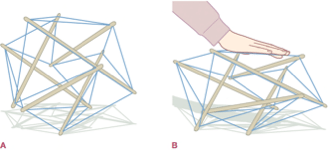
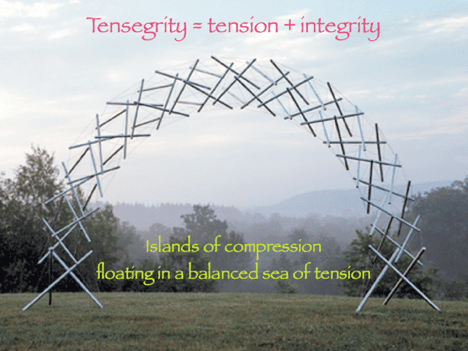
Add the ligamentsA dressed skeleton and the bones would mostly hold in a general relationship, but of course the whole thing would sag and fall. The muscles would drip off without the restraining (tensegrity) of the superficial and attaching fasciae. The body is a tensegrity (or at least ‘tension dependent’) dance between the myofascialature and the skeleton. The classroom skeleton makes it seem a steady frame on which the muscles can be hung, on-by-one, till it can move. Not so. Bones float in the soft-tissue, pushing out against it; soft-tissue pulls in, holding it together and holding it up in a tough but delicate tension-compression balance.

2) The hardware on a skeleton gives many false impressions – the bones of the feet wired together with no movement at the sub-talar joint, giving the casual observer a false idea about the ankle in eversion and inversion. The fibula would fall without wire ties, etc. And then there’s that metal rod up its bum from sacrum to skull. Modern skeletons seem to have given up wiring the ribs to the neck (which at least imitated the scalenes) for an entirely unrealistic rod between the front of the throacic spine and the back of the sternum – talk about a spear through the heart!

The scapula is usually nailed to the rib cage, giving the impression that the arm appendage starts at the gleno-humeral joint, instead of the sterno-clavicular joint.

Most cheap skeletons have U-joint hardware at the shoulder and hip, which works well enough for most demonstration purposes, but spoils our sense of the biomechanics of the rotator cuff and the psoas complex. More expensive models have gone to flexible spines and bungee cord joint connectors, which, though they give up the ghost sooner than the metal hardware, are much more accurate in ball and socket mechanics.

3) But the worst of all is the choice of which cartilage to include and which to ignore. Most include the pubic symphysis, the intervertebral discs, and the costal cartilages between the ends of the ribs and the sternum. Some plastic skeletons include the knee menisci.

Most skeletons wire the hyoid bone to the front of the neck vertebrae, which is accurate positioning, but inaccurate in function. None to my knowledge include the laryngeal crichoid, or tracheal cartilages under the hyoid, which extend down into the bronchae and bronchioles before terminating in the (epithelial) alveoli. Neither are the ear nor nose cartilages or the linings of the eustachian tubes included.

Of course most bones start as cartilage and are progressively ossified, so the decision of which cartilages to include is a matter of convenience and production costs, which I appreciate. But nevertheless, it is a political statement of inclusion and exclusion. An inclusive skeleton would have these cartilages of the throat and chest, and would suggest a ‘visceral’ skeleton (an idea I lifted from Jon Zahourek) to add to the axial and the two parts of appendicular skeleton. This visceral skeleton would include the ‘breastplate’ of the sternum and costal cartilages, the pulmonary cartilages mentioned – the entire upside-down tree of the respiratory and vocal superstructure, plus the hyoid, mandible, maxillary, palatine, zygomatic, nasal, and lacrimal bones – mostly derived from the proto-gill arches of the embryo. The head scratcher in this would be the vomer: firmly in the nose, it seems part of this visceral skeleton, but it could also be seen as the ‘spinous process of the sphenoid ‘vertebra’.

Expansion and Contraction

Monday, June 6th, 2011

A student recently asked me to discuss prenatal and postpartum fascial changes in terms of “normal” tension, moving to expansion and contraction. So, I’d like to talk about this in three ways:

1) Movement function: You can see the body as seven hinged ‘masses’ (meaning heavy bits: the head, chest, pelvis, arms and legs) with six rotational ‘spaces’ or swivels in between (the neck, waist, shoulders, and hips). In pregnancy, you add a large incompressible mass into the waist section. In early pregnancy, this makes little difference, but by the last months, and the last two weeks in particular, the weight of the baby and the amniotic fluid tend to lock together the rib cage and the pelvis masses into on big mass. This puts special movement requirements on the woman in late pregnancy (not to mention difficulty breathing – ever tried running upstairs in the ninth month?).

Clinically, I find many women need restoration of the rotational aspect of the waist, and that exercises and awarenesses that go in this direction are very helpful.

2) Tissue stretching: Without doubt, the growth of a baby stretches tissue, a day at a time, and of course the pelvic floor tissues in a hell of a hurry. Linea alba diastasis, stretch marks in the dermal layer, and a less-than-adequate pelvic floor tone are all common sequelae from pregnancy and delivery. Inevitably, the uterus sits more forward than backward, because of the lumbar spine behind. All the abdominal muscles and fasciae are stretched, and despite the well-toned mother’s best efforts, the baby tends to stick out over the pubic bone in late pregnancy. This position puts great strain on many organ and ligament attachments – too many to predict, as it depends on the mother’s posture and the baby’s position.

Assisted restoration can use bodywork, exercise, and such devices as sacral belts when necessary. Natural restoration varies due to the mother’s inherent fascial elasticity, muscle tone, and nutrition – and whether they are nursing or not.

3) Birth hormones: A cousin of oxytocin called relaxin is secreted in the mother’s body starting a bit before birth (it varies) and some time after birth (longer with nursing), and this causes fascia all over the body to relent a little – making the mother a bit like someone with ligamentous laxity or hypermobility. It’s a good idea to release the ligaments around the pelvis to make the birth easier, but it makes restoration harder.

Oxytocin is also the love drug, and fixates the mother on the child, to the detriment, sometimes, of herself. Good bodywork soon after delivery can be vital in restoring proper span to the pelvic floor and proper joint relations, but often the mother is ignoring her own feelings in favor of the baby’s well-being. It is up to us, members of her community, to make sure she gets the proper post-natal care. I have a very baby-friendly practice – on the breast, on your stomach, beside you on the table, beside the table in a basket – whatever the mom wants. But get in here and get the pelvis re-aligned before the relaxin disappears (certainly by about 6 months in most) and restoration gets harder.

In general, fascial tissues restore slower than muscular ones, though muscular effort can aid the fascial restoration. Fascial tears or adhesions will slow or distort muscle action. Malalignment in the SI joints or pubic symphysis affects both. All these are most easily adjusted and combed out in the first couple of months after birth.

In a proper society, we will make sure that all mothers have sustained pre- and post-partum structural care that will ease the birth process and speed the restoration to full function afterward.

One Plus One Makes Three

Wednesday, November 10th, 2010

Along with the Tensegrity You Tube I FB’d yesterday, this wonderful lecture on the basics of tensegrity in the body is worth a read:

8th International Congress of the F.M. Alexander Technique 10 – 16 August 2008 in Lugano, Switzerland

Lecture by Doris Dietschy, Basel, Switzerland

One Plus One Makes Three

(Buckminster Fuller’s principles of complementary forces as a way to understand our ability to balance and move)

I want to talk today of the synergetic quality opposing forces may show when they meet in a intercomplementary situation. Synergy means that a system as a whole (the human body for instance) functions in a new quality very different from what could be predicted from studying all the single parts involved.

I do not talk to you as a physicist, but as person who spent more than half of her professional life in the architectural world. Working later as an Alexander Teacher meant to get into contact with a new aspect, but again one of architecture. My eyes, my fascinations and my feelings continue to be those of a designer.

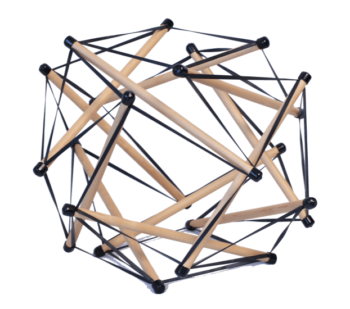
The person who spent a lifetime to explore the principles and conditions of synergy was the American ingenious engineer, inventor, artist and philosopher Buckminster Fuller, (P 1),who lived from 1895 – 1983. With his structural models he made the invisible forces involved experienceable and useable, and if we Alexander teachers ever heard about him, it is thanks to the structural system called „Tensegrity“ (P 2), to the Tensegrity models or even to Tensegrity toys. Tensegrity is Buckminster Fuller’s abbreviation for „tensional integrity“ on which the system is based. He himself applied it mainly for architectural constructions (P 3) and with them he found his first acknowledgement. Later biologists and physicians began to apply the models and principles to their work and so did people interested in body functions like us, with the result, that Tensegrity might even be misunderstood as a new theory in natural science or a new therapy. It is not. It is a structural reality and Fuller’s name for his demonstrations of basic principles, to be discovered everywhere in the universe, including our living bodies.

For me his most important contribution is that he developed ways to really show how principles of energy and synergy work. He showed that they do so in the macrocosm, in the scale of our daily world, as well as in the microworld. Fuller was deeply convinced that with the help of his models he could speak to the senses directly and encourage new ways of comprehending which he called “embodiments of mind.“

To demonstrate for instance why he calls the triangle (P 4) the “minimum flex-cornered polygon … that holds its shape“ Fuller uses three tubes strung on a dacron string. Pulling the loose ends slowly closer and closer together he obtains in the end a triangle. Its stabilitiy is not dependent on any fixed angles or corners but uniquely on the intercomplementarity of two forces: one, that of the pipes which push out against each other so that each pipe always stabilizes the opposite angle built by the two other pipes. The other force is that of the through (1) running string which continuously pulls. The result is synergy pure: an absolutely stable triangle, with new qualities not predictable by the qualities of its components. In the tetrahedron, the polygon built of 4 triangles, Fuller finds “the minimum structural system of the univers“. (P 5) We find it in the microworld of molecules, cells, viruses, etc as well. The various Tensegrity models (P 6) are elaborations of the same principles, demonstrating that stability can be gained without fixing the solid parts to each other and hence maintaining flexibility throughout the whole structures.

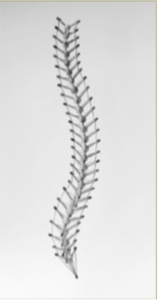
The human body as a whole can be understood as one Tensegrity system (T 7), a stable- flexible structure. Within that system the heavy bones push outwards, away from each other. Connective tissue (as the name says), muscles and skin constitute the complementary force of inwardly directed tension throughout the whole body. Looking into this one whole Tensegrity body you can detect smaller partial Tensegrity systems, such as, for instance, the pelvis (P 8) with its bony parts tending to move apart and outwards. The strong short muscles, tendons, fascia and ligaments draw it together to a very stable yet still flexible structure. To look at the spine (P 9) from a Tensegrity point of view reveals a combination of all principles: Vertrebae with their inner tetrahedron like texture are resistent to pressure and take on the role of struts. All intervertebral discs are complete Tensegritysystems by themselves: under pressure their liquid kernel pushes out to the elastic hull which tends back in. They function like shockabsorbers between the vertebrae. Again, connective tissue and muscles around and all along the spine complement in such a way that the whole spine functions as the stable- flexible and load bearing structure we count on.

Anatomy books describe the bony structure of the body as the part which carries load and gives the body its dimensions, while muscles and connective tissue provide stability for the skeleton and move the bones. It is a truth which nevertheless leads to the misunderstanding of many body trainings, that optimal body stability requires a maximum work of muscles. True, muscles do stabilise. But over trained, chronically hard working muscles shorten and thicken (T 10). They loose their elasticity, their ability to lengthen and they constantly press onto the organism. Mobility and stability seem to oppose each other.

Is this contradiction a fact we have to accept? (T 11) Buckminster Fuller’s research and structural models prove a different truth: that the human body synergises mobility and stability into the mobile, stable-elastic condition which is so significant for human beings.

I repeat: in our bodies the heavy, compact bones tend to move – or shift – apart and so trigger the stretch resistence of the tissue and the muscles which then contract. Or the other way arround: the abiltiy of tissue and muscles to respond to the moving apart of the bones by maintaining elasticity in contraction allows the bones to move freely, with unfixed joints. This continuous interplay of forces works in all positions (P 12), no matter how or where you stand, on your feet, on your hands, hanging or floating and garantees the intergrity of the whole bodily system. Fuller demonstrates these principles with construction material. But they are just as true for living beings and we can rely on them.

Men and animals also have an extended and complex nervous system. The diversity of the system allows it to initiate muscle reactions to maintain positions independently of our awareness and it provides us at the same time with the possibility to make conscious decisions to act and to steer our actions according to our ideas, needs and judgments. We are able to transform our energy into willed action. Different from unanimated objects we can move on our own will and we can actively influence our surrounding.

However, in spite of a reliable body structure and the most extraordinary nervous system, to be active in this world our body is dependent on forces which counteract to it’s weight. To move from one place to another I am dependent on a world outside of myself, which is solid enough to resist and support me whith its forces of substance and form, from which I can repel. The more dense for instance the ground is on which I want to move, the easier it is to walk on it. Walking on sand is more difficult, because the loose sand lacks density to resist my weight. We cannot walk on water, but in the water, when I do the swimming movement, I push back the water with my arms and legs while I am pushed forward by the water’s resistance.

I want to move a heavy object. Its weight is a force which resists mine. To overcome it (P 13) I push by repelling from the floor or even from the wall behind me. It is with my weight that I apply force upon the ground under me. Its density determines the force of resistance which is directed back toward me, along my entire structure. Or in a physisict’s terms: Resting objects exert forces against their supports and at the same time the supports exert an upthrust against the object resting upon them.

Balance, too, results in an interplay of forces. Take for instance some large pieces of stone, one put on top of the other to form a pillar (P 14). They are heavy, dense, and therefore resistant to pressure. Because of this resistance they may be considered as actualle pushing away from each other. It is the gravitiy of the enormous mass of the earth, which ‚catches’ them back into a stable balance between the two forces, perpendicular over the center of the earth.

Yet the parts of the human body very rarely arrange neatly one on top of the other (P 15) like the stones in the examples before. Every movement contradicts that state. Moving I leave the balance I just had. Moving I risk that my bones fall asunder. Yet I trust, that my connective tissue and my muscles bind the bones which move away from each other back to a new balance, which again allows a next shifting away into a next balanced movement.

In every movement the body parts shift away from each other. Let’s have a closer look (P 16) at a diagram of a person in the act of squatting, seen from the side. Use your imagination to see and sense how the weight of that person is delivered throught the bones to the ground. The ground resists with its density force in the opposite direction, in this case upwards along the bones. The lower legs receive it in an angle of about 45°, the thighs receive it in a counter angle of maybe 90° and hand it on to the trunk and head, again in an angular direction. Each part has its specific center of weight, wide apart from the others. It is the correlation with the continuous contracting, yet elastic quality of connective tissue, skin and muscles arround each bony part and throughout the whole bony structure which assures the synergetic integrity of the body in every movement.

These dispositions we all bring with us to this planet and this planet meets us with its permanent support, allowing us to employ our structural freedom in all dimensions.
As said before we can discover the working of the complementary forces in unanimated as well as in animated nature. The more we know, understand and embody these principles, the more we can let them work for us, in each moment, in every act, as a basic in the use of ourself.

Constructive use of the self includes my awareness that it is a multitude of systems, (T 17), which interact into one functioning human being. Many of these systems function autonomously. Others, like our voluntary breathing, are also influenced by our consciousness. The most elaborate in this regard is the nervous system, which steers most functions without our being conscious of it and has at the time brought forward a human brain and mind, capable to generate conscious goals, needs, believes, fears. actions etc, developed during evolution, and also in every individual life.

We consider ourself as self-determining beings, sometimes to such an extent that we believe we ought to or could will our whole organism or steer all of it consciously. I use Mind over Body as a headline for this attitude.We all know of the opposite idea: Let the wisdom of the organism find its best way and the headline could be Nature over Mind. (T 18)

It is my strong belief that no hierachical either – or point of view is of any help, For our existence in this complex world we are dependent on a multitude of different well functioning systems in us. One of them is what we name our consiousness and self determination. A very different one, one of many, is what I call the Tensegrity system in us, our autonomous inborn mobile-elastic stablity. (P 19) The aim of this lecture is to demonstrate how interactive complementary forces within us and without us bring forth a synergetic third condition, which is more than its parts. This is a truth which can be experienced kinesthetically, as mobility within stability and stability within mobility. Simply put, we move with more trust with this understanding.

And to finish I would like to cite my favorite quote from Buckminster Fuller, which says: (T 20) Unity is plural and at minimum two (Fuller 1992, p. 57)

Bibliography

Fuller, R. B. Cosmography (1992) Estate of R. Buckminster Fuller
Fuller, R. B. Your Private Sky (1999) Lars Müller Publishers
Fuller, R. B. Your Private Sky – Diskurs (2001) Lars Müller Publishers
Roberts, T. D. M. Understanding Balance (1995) Chapman & Hall
Levin, St. M. (1998) A different approach to the mechanics of the human pelvis: Tensegrity’ ATI Exchange 6 / 2; pp. 1, 4-10
Levin, St. M. (1998) ‘Continuous tension, discontinuous compression’ ATI Exchange 6 / 2; pp. 25 – 27

Doris Dietschy had her first experience in the Alexander Technique in 1979. She trained with Y.Kuperman and was certified 1985. She maintains a private practice in Basel, Switzerland, and taught from 1991 – 2005 as co- director at Kathrin von Schroeder‘s Training Institute for F.M. Alexander Technique in Basel, Switzerland. She owes much to the work with Walter and Dilys Carrington, Shmuel Nelken, Marjorie Barstow, Tommy Thompson, Joan Murray and intensiv exchange with Barbara Conable. She was member and chairman of the bord of the Swiss Society / SVLAT and director of the 6th International Congress of the F. M. Alexander Technique, 1999, in Freiburg, Germany

Doris Dietschy, Bäumleingasse 6, CH – 4051 Basel, Switzerland e-mail ddietschy@bluewin.ch www.emindex.ch/doris.dietschy