Anatomy Trains Myofascial Meridians A Revolution in Soft-Tissue Patterning

Anatomy Trains Introduction

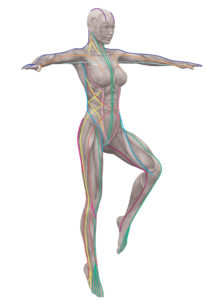
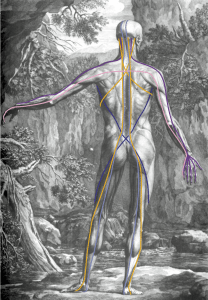
Anatomy Trains is a unique map of the ‘anatomy of connection’ – whole-body fascial and myofascial linkages. The Anatomy Trains concept joins individual muscles into functional complexes within fascial planes – each with a defined anatomy and ‘meaning’ in human movement.

Anatomy Trains leads to practical new holistic strategies to improve stability, coordination, and resolve long-standing compensations in postural and movement patterns.

Developed by author and bodyworker Thomas Myers in the 1990’s, Anatomy Trains has been welcomed and put to use by diverse health professionals – physical therapists, personal trainers, massage therapists, athletes and coaches, Pilates and yoga teachers, chiropractors and osteopaths – anyone interested in effecting lasting changes in body structure and movement through updating their idea of how the body regulates its biomechanics.

Anatomy Trains has been progressively supported with books, videos, dissections, DVD-ROM’s, posters, and other ancillary material designed to make it easier to apply the Anatomy Trains ideas in diverse therapeutic and educational contexts.

Anatomy Trains offers CEU-accredited short courses and longer certification trainings worldwide to convey the ideas, strategies, assessment tools, and techniques that grow out of the Anatomy Trains understanding.
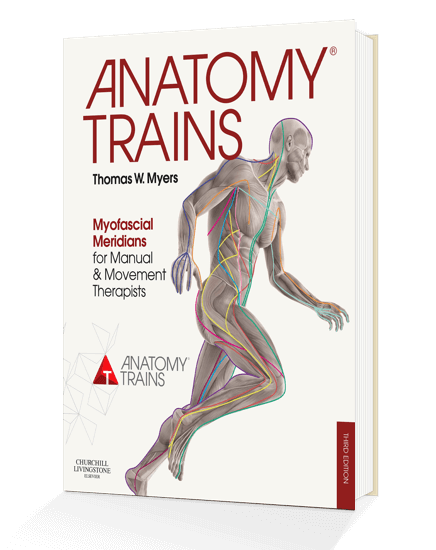
Anatomy Trains Myofascial Meridians gives you a new understanding of whole-body patterning in posture and function – the interplay of movement and stability. Understanding the ‘Superficial Back Line’ as a whole gives insights into hamstring problems that you cannot get from considering the hamstrings alone. The ‘Spiral Line’ shows how to resolve rotational compensations in a way that no analysis of any single muscle can give.

From the individual cell to the social and cultural context, we are investigating morphogenesis, as well as morphostasis and morphokinesis – how we take form, how we get stuck, and how we mature and grow out of such restrictions. We call this ‘Spatial Medicine’ – how do we optimize the mechanical relationships in the body – either to repair injury or improve performance? The overall context is to improve our ‘KQ’ – our Kinesthetic Quotient, or body intelligence.

Next: History

A Brief History of Anatomy Trains

Tom says: “I developed the Anatomy Trains during the 1990’s as a game for students to play when I was teaching Fascial Anatomy at the Rolf Institute . All the books you can find put forward the ‘single-muscle’ theory, but Ida Rolf kept saying, “It’s all connected through the fascia.” Other than invoking the image of a grapefruit or a loofah, how do you make this real?

“Just as an exercise to cement the students’ knowledge, I began stringing the muscles together through the fascia. This idea was initiated when Dr Jim Oschman gave me an article by Raymond Dart, anthropologist and Alexander Technique student, that linked the muscle in the trunk in a double-spiral arrangement (which shows up here as part of the Spiral Line). Using this as a base, I expanded Dart’s idea to the whole body, to help students see connections by stringing muscles together like sausage links – anywhere that went, or could go in some positions, in a more-or-less straight line.

“After a few teaching iterations, the whole project became so interesting that I started to systematize these connections, with the help of my friend Annie Wyman, and the picture of the lines started to become clear. I started to see the lines in assessing my clients, and then started building sessions around these lines.

“Moving toward publishing happened as a happy coincidence. One of my students (in my very small early classes for massage therapists in Maine) loved these lines, and said, “I’m going out to Hawaii to teach these lines to Lee Joseph’s students!” (His was another structurally-related school of bodywork.) I realized that if I was going to lay claim to this idea and have it come out correctly, I needed to write it down. At the same time, Leon Chaitow, N.D., D.O. was forming the Journal of Bodywork and Movement Therapies, and was calling in his chits with all his old friends to get articles to start this venture off.

“These original Journal articles proved so popular that Churchill Livingstone (who has since been swallowed by Harcourt, which was in turn swallowed by Elsevier) asked me to write a book on the idea. The book was published in 2001 and has now been (or is being) translated into seven other languages – German, Portuguese, Italian, Korean, Japanese, Russian, and Chinese.

“After the original publication, I found earlier iteration of similar ideas – in the meridians of acupuncture, of course, but also in the sketches of Leonardo, in Hoepke, a German anatomist of the 1930′s, and in the work of Françoise Meziére in France.

“Later, it struck me – suddenly, like Saul on the road to Damascus – that the Anatomy Trains schema offered a logical lens through which to view Ida Rolf’s ten-session Structural Integration recipe. In other words, the recipe could be reconfigured slightly to unfold via a progressive opening of these lines. Thus, Kinesis Myofascial Integration (KMI) was born.

“Structural Integration (popularly known as ‘rolfing’) always labored under the burden that, when asked why the ‘recipe’ proceeds as it does, the answer is, “Well, Ida said…” The Anatomy Trains gives a logical reason for the progression of the SI sessions, understandable by professionals and the public alike. Students seem to agree, and the KMI Professional Certification has flourished since, with nearly 200 fully-trained practitioners in the US and abroad.

“Since 1998, I have taught more than 200 workshops in the Anatomy Trains. To my surprise, interest has burgeoned from the original audience of massage therapists to PT’s, chiropractors, yoga teachers, and personal trainers. Because the increasing demand outstripped my ability to be everywhere at once, we have created more supporting products and trained a diverse and wonderful Kinesis faculty to spread the Anatomy Trains ‘gospel’ – a systems-oriented view of our musculo-skeletal anatomy.

“There are now 10 DVD programs to support the Anatomy Trains idea – two introductory overview illustrated lectures and eight technique videos that cover all the lines – as well as a striking DVD-ROM we produced in collaboration with Primal Pictures.

“In 2004, and again in 2006, we went into the dissection lab and came out with some revealing photo and video confirmation of the Anatomy Trains as palpable entities in the human body.

“With the advent of the extended faculty, the translations into a variety of languages, the interactive forum and application sections of this site, Anatomy Trains is rapidly becoming a world-wide participatory event in getting connected through the neuro-myo-fascial web!”


Next: Who’s Who

Meet the Anatomy Trains faculty below

Anatomy Trains Associate Teachers

The following are our Associate Teachers, who are in training to become Certified Teachers for Anatomy Trains. They have completed the Teacher Training course and are currently doing their ‘apprenticeship’, including supervised teaching under Tom and our senior teaching staff. These folks are approved to teach ‘Associate Courses’ using materials provided by Kinesis. These courses are offered in association with Kinesis to inform the public and practitioners about Anatomy Trains, but are not official Anatomy Trains workshops and thus cannot be used to satisfy the prerequisite for our certification trainings such as Body Language and KMI.

Aimee Baker, USA
Raphael Brand, Switzerland
Thuy Bridges, Australia
Noémie Chabot, Canada
Ron Coutts, Scotland
Thadd Dudrey, USA
Cristina Ferri, Italy
Jeff Frank, USA
Sherri Iwaschuk, Canada
Peter Lakis, USA
Elizabeth Larkam, USA
Karin Locher UK
Andrew Mannino, USA
Laurice Nemetz USA
Donielle Saxton, USA
John Smith, Australia
Marie Steadman, UK
Shelly Stephenson, USA
Charlotte Trux, USA
Kristen Vance, USA
Tomasz Zagórski, Poland


Next: Resources

Videos


Photos

Articles

  • BodyReading the Arm Lines – Tom explains the arm lines in the article from the March/April 2012 issue of Massage and Bodywork
  • Dissection – See a preview article of the Anatomy Trains dissection material

Next: Introduction